

Sympatec Particle Size Analyzer for Powder Coating
Analysis of pigment particle size for powder coatings improves production efficiency
The reality
The ingredients for powder coating are essentially epoxy resin and polyester resin, which function as matrix and binding agents for solid particles and harden the finish. Various additives, aggregates and fillers are added to create special effects (like mattfinish, high polish, metallic look and pearl luster effect) or to produce durable, dirt-repellent and environmentally-resistant surfaces.
Together with colored pigments the formulation is weighed and homogenized by mixing and extruding. While melting the resin particles, solid coating components are evenly dispersed and incorporated into the matrix. During the cooling process, the melted mass solidifies, it is then crushed into coarse powder chips before it is ground into a fine powder with defined grain size distribution using a classifier mill. Finally the product is sieved to remove coarse particles.
Control of the particle size distribution of ground powder coating is essential for economic processing operation as well as for the final paint surface quality. A narrow distribution between 10 µm and 90 µm would be ideal.
The solution
For quality control of ground, fine powder coating in the laboratory, HELOS laser diffraction with RODOS dry dispersion is used. Pressurized air dispersion and measurement of the free aerosol jet delivers reliable, reproducible measuring results within seconds. A very high sample throughput rate is achieved without the need for sample preparation or routine cleaning.
Recommended Sympatec Particle Size Analyzer configuration
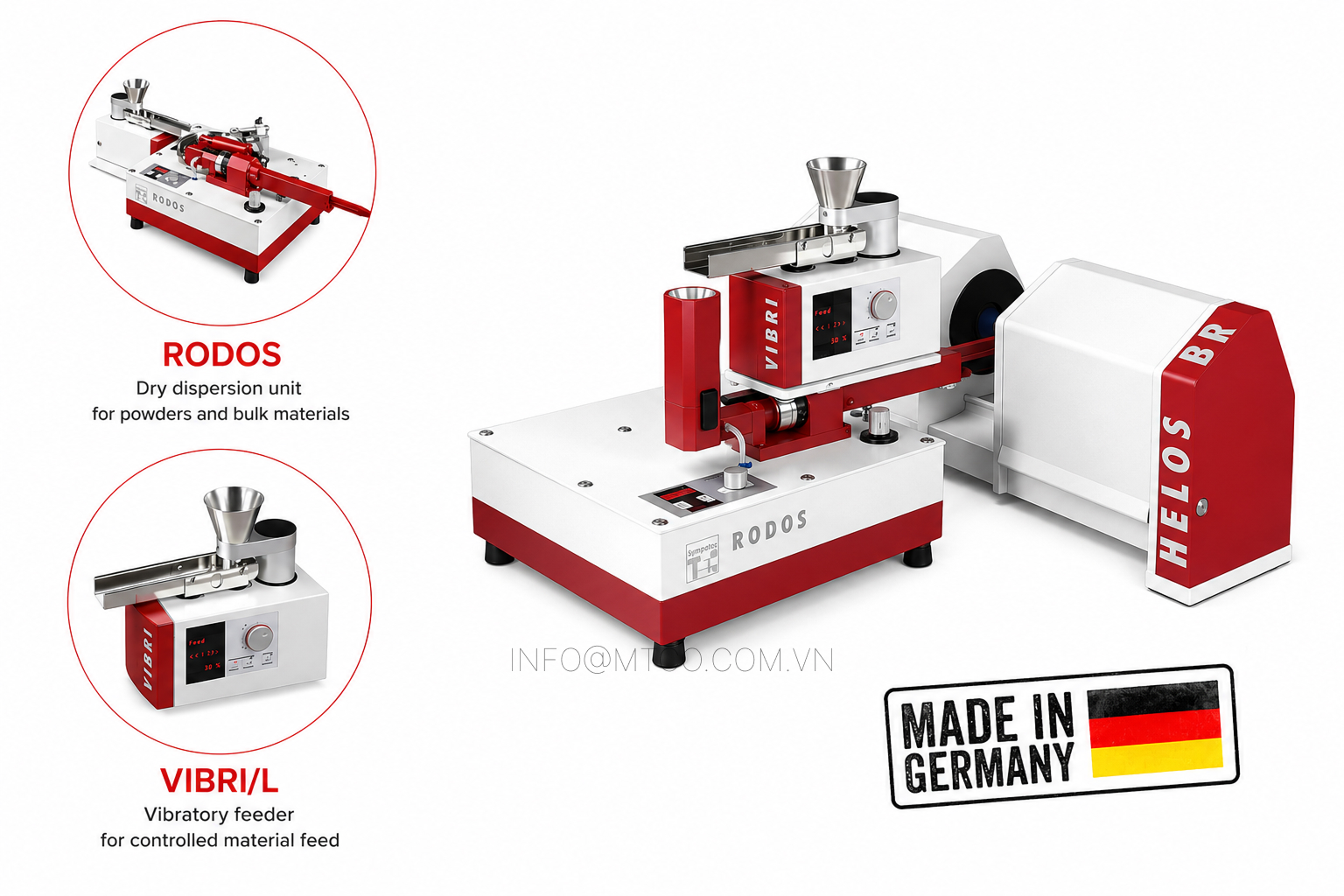
Laser diffraction sensor HELOS/BR Multirange 0.1 - 875μm with Dry Disperser RODOS and Precision vibratory feeder VIBRI/L
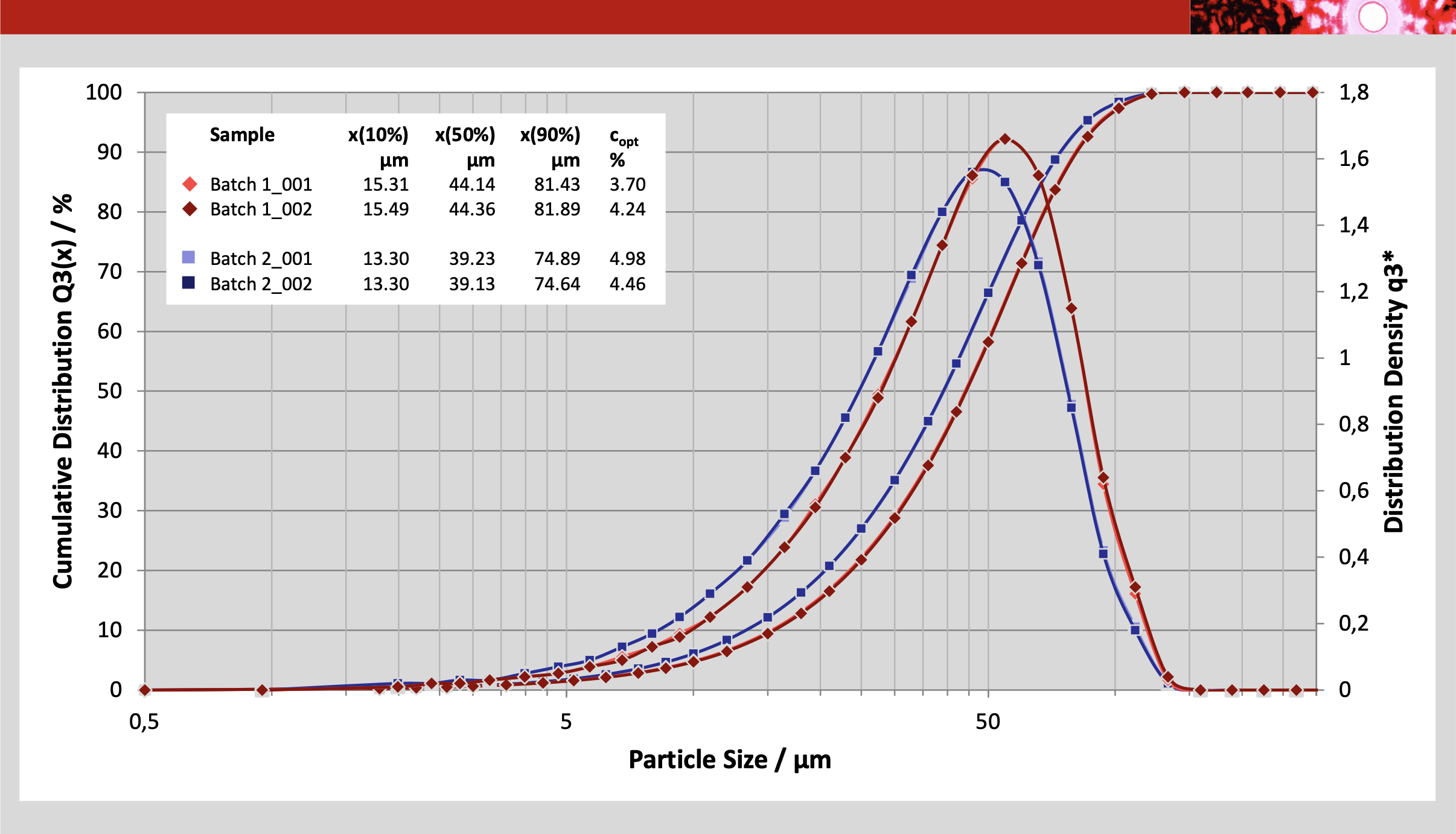
Measurement results Powder Coating | 2 batches
Application strengths
- Free aerosol jet for best dispersion and reliable measuring results
- Fast product quality analysis of fine dry powder, typically in less than 20 seconds
- Dispersion forces adaptable to the product
- Excellent repeatability
- Analysis of statistically relevant sample amounts
- Easy handling and almost no product residue in disperser
- Quick change-over to new or different products without cross-contamination
The benefits
- Production of powder coating with verifiable quality through documentation of particle size distribution
- Improvement of production efficiency and reduction of off-spec batches
- Quick adjustment of process-settings during change-over
- Dry dispersion eliminates sample preparation effort
Powder coating performance is highly dependent on the particle size distribution (PSD) of the final powder. An optimized PSD ensures excellent powder flow, stable electrostatic charging, uniform deposition, high transfer efficiency, and a smooth, defect-free surface finish. Variations in particle size can lead to poor fluidization, inconsistent film thickness, orange peel, pinholes, and reduced coating quality. Therefore, accurate PSD analysis is a critical quality control step throughout the manufacturing process, from milling and classification to final product inspection.
The Sympatec HELOS/BR laser diffraction analyzer combined with the RODOS dry dispersion system provides fast, precise, and reproducible measurements of dry powder samples under production-relevant conditions. By continuously monitoring particle size distribution, manufacturers can optimize milling parameters, maintain batch-to-batch consistency, reduce production waste, and ensure that powder coatings consistently meet customer specifications and performance requirements.
Sources: