
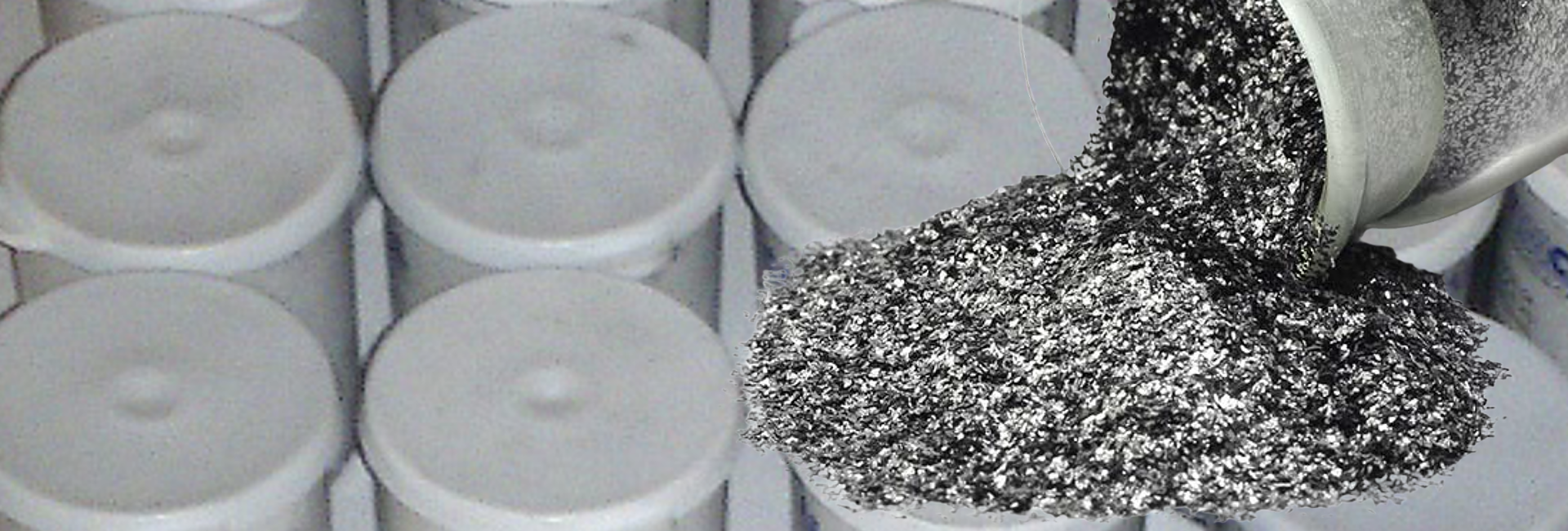
Particle size and shape of graphite powder
Graphite batches with similar particle size distributions sometimes have significantly different properties in further processing and different qualities of the end products.
The reality
Graphite is a natural manifestation of pure carbon with a special hexagonal crystal structure that is arranged in several parallel levels, called graphene layers. This anisotropic structure gives the graphite special properties, such as electrical conductivity or a particular strength along the individual layers, as well as slight fissility and good sliding and lubricating properties. On top of that, it is extremely heat-resistant with a sublimation point of over 3,800°C, thermally highly conductive and chemically inert. Its use as a material is accordingly diverse, e.g. for electrodes, batteries or sliding contacts (brushes), in refractory products and melting pots, for composite materials, self-lubricating bearings or generally as a dry lubricant. Naturally occurring graphite is mined and processed. However, graphite is also artificially manufactured in significant quantities by coking suitable carbonaceous materials and subsequent pyrolysis (graphitisation) in the required qualities.
The final particle size of the graphite required for further processing or direct application is achieved using various grinding processes The size, shape and size distribution of the particles is ultimately determined by the functional properties of the graphite and the quality of the final products. Traditional screening analysis and microscopy are often still used to analyse the particle size and particle shape. The laser diffraction and dynamic image analysis provide significantly more powerful methods of characterising the size and shape of the graphite particles.
Batches with similar particle size distributions sometimes have significantly different properties in further processing and different qualities of the end products. Here it is worth using the dynamic image analysis with QICPIC to gain a complex insight into the particle shapes and different shape parameters. If, for example, you consider the aspect ratio as a shape parameter – i.e. the maximum dimension of a particle in relation to the minimum dimension – there are significant differences between the four batches. For example, Batch 4 (S50%, 4=0.57) has a significantly higher proportion of long particles on average compared to Batch 1 (S50%, 1= 0.86).
The solution
- 4 graphite samples with similar particle size distributions, but with different final product properties.
- Wet measurements with up to 2 times higher resolution and better shape recognition then dry applications.
- Optimised shape detection with the wet disperser SUCELL and 0.2 mm flow‐cell using measuring range M3.
Recommended Sympatec Particle Size & Shape Analyzer configuration

Dynamic Image Analysis sensor QICPIC measuring range M3 0.55 - 1,126μm and Wet Dispersing Unit SUCELL/L

Four graphite batches with similar particle size distributions, but which have different product properties.

The aspect ratio provides values between 0 (long) and 1 (compact). Batch 1 is characterised by a high proportion of compact particles, while the other three batches have a higher proportion of long particles.

The particle gallery provides illustrative examples of typical particles from Batch 1 (more compact) and Batch 4 (more long).
The benefits
- Measurement over the entire particle size range with very good resolution
- Easy sample preparation
- Automatic setting of all measuring parameters
- Short measuring times for high sample throughput
- High reproducibility and good comparability of the measurement results
Controlling the size and shape of graphite particles is critical to achieving consistent performance in applications such as carbon brushes and battery materials. Variations in particle size distribution and flake morphology directly affect electrical conductivity, packing density, wear behavior, and process stability. The Sympatec Particle Size & Shape Analyzer QICPIC, combined with the Wet Dispersing Unit SUCELL/L, provides reliable and reproducible characterization of graphite under real process conditions. High-speed dynamic image analysis enables simultaneous measurement of particle size, aspect ratio, and flake shape, while wet dispersion ensures effective deagglomeration without damaging fragile graphite flakes.
This combination allows manufacturers to monitor raw materials, optimize formulations, and maintain tight quality control, resulting in improved product consistency, reduced defects, and more stable manufacturing processes.
Source: