

Particle size distribution of Casein Micelles in milk
Analysis of bimodal particle size distributions of casein micelles in milk
The reality
Milk is a natural product originating from animals and is used as a basic food and raw material for a variety of dairy products. Various types of milk and cheeses, cream, butter or sour milk products are used for direct consumption. Milk is an aqueous, white, cloudy emulsion (colloidal dispersion) consisting of partly dissolved minerals, vitamins, lactose, proteins and fat droplets. The milk fat contains unsaturated fatty acids and the fat-soluble vitamins A, D, E and K. Colloidal casein calcium transport complexes, known as casein micelles, are at the heart of the milk system. The main function of the micelle is to swirl the casein molecules and to dissolve calcium and phosphate.
Creaming behaviour, stability, texture and the processing properties of milk depend on the fat content and the particle size of the fat droplets and casein micelles. Homogenisation takes place for various types of milk in order to break up the fat droplets, spread them evenly and thus improve the stability of the emulsion. The fat droplets of the raw milk originally have a broad size distribution between 1 and 10 microns. The homogenisation process results in the fat droplets being cut up to a size of less than 1 to 2 microns under the influence of high pressure. Casein micelles act as stabilisers responsible for the longevity of the milk and to prevent the phase separation of fat and water. The size, shape and structure of the casein micelles are very important in the dairy industry, particularly for cheese production. Differences in the particle size of the casein micelles can influence milk processing, and also cheese production. The size of the casein micelles is an important feature of the raw milk and determines the yield of dairy products.
Dynamic light scattering with photon cross-correlation spectroscopy (PCCS) is recommended for the detection of fat droplets and casein micelles because this method reliably identifies the slightest differences in size down to the nanometre range, even in cloudy samples. The results obtained can be used to improve the homogenisation process, the function of the casein micelles and thus to increase the milk quality.
The solution
Two types of milk with low and high fat contents have been analysed
- Skimmed UHT milk | 0.3% fat
- Whole milk | 3.9% fat | whole milk was filtrated at 450 nm to reduce concentration of fat globules
Recommended Sympatec Particle Size Analyzer configuration

Dynamic Light Scattering sensor NANOPHOX CS measuring range 0.5 - 10,000 ; disposable measuring cell - 4ml acrylic cuvette
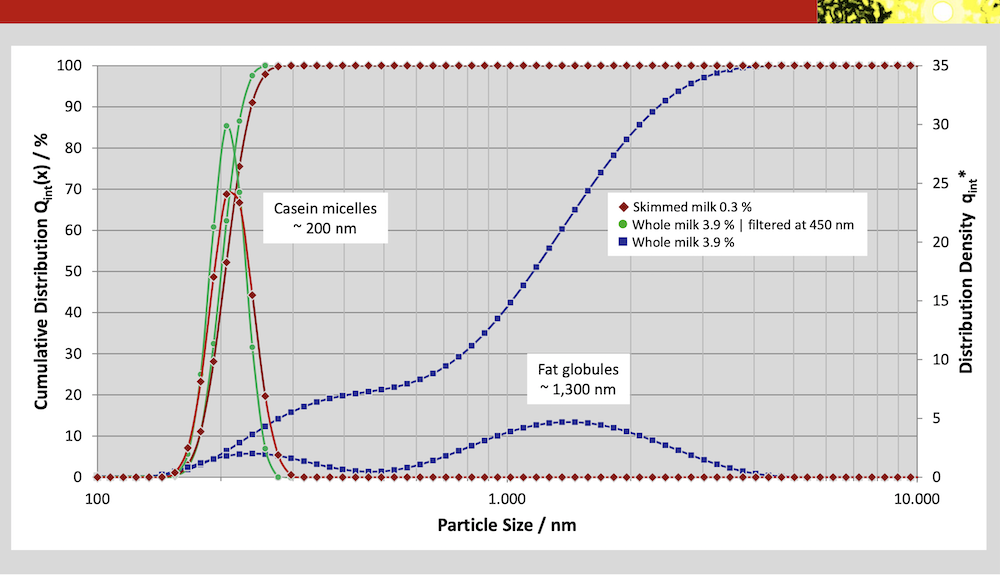
Intensity-weighted particle size distribution of skimmed milk, whole milk and filtered whole milk to demonstrate the size of the casein micelles
The graph shows the intensity-weighted particle size distributions of the two described types of milk. The skimmed UHT milk with the lowest fat content of only 0.3 % has a mean size of 205 nm. Here the fat content is negligible small. Only casein micelles can be detected. The whole milk with a fat content of 3.9 % shows two modes, one around 250 nm and one around 1300 nm. The fine peak represents the casein micelles and the coarse the fat globules. After filtration at 450 nm the concentration of the fat globules is negligible small. Only the casein micelles are visible in the particle size distribution.
The benefit
- Simple and stable measurement method
- Particle size measurement for final quality inspection
- Measurement of cloudy emulsions
- Measurement of bimodal particle size distributions
Measuring the size of casein micelles in milk is critical for understanding stability, texture, and processing behavior of dairy products. Using the Sympatec NANOPHOX CS particle size analyzer with Dynamic Light Scattering (DLS) allows precise characterization of micelle size in the nanometer range under native conditions. Accurate micelle size data helps optimize homogenization, heat treatment, and formulation, ensuring consistent product quality, improved shelf life, and better control of functional properties in milk and dairy-based beverages.
Source: